
Read Gove County Tax Records
A tax record in Gove County is a chain, not a single sheet. The Appraiser first discovers, lists, classifies, and values taxable property. The Treasurer then takes the certified roll and sends statements. It collects the ad valorem tax along with special assessments. It also pursues delinquency. Before comparing any figures, line up the parcel number, legal description, tax year, and classification. Mailing names change. The land description usually does not.
| Field | What It Shows | Where |
|---|---|---|
| Appraised value | Annual fair-market estimate as of January 1, except special methods such as agricultural use value | Appraiser roll and ORKA |
| Assessed value | Appraised or use value multiplied by the Kansas classification rate | Appraiser roll |
| Classification | Residential, commercial, vacant lot, agricultural land, farm building, or another statutory class | Appraiser record |
| Levy and tax | Rates applied to assessed value and the resulting amount billed | County levy sheet and Treasurer |
| Payment or delinquency | Whether a bill remains due and whether later action changed its status | Treasurer, statement, and public notice |
Taxes do not come straight off a likely sale price. Kansas applies a class rate to the appraised or use value first. Mill levies are then applied to that assessed amount. A deed may show sale consideration, but that number belongs to the transfer record. For a fuller comparison of the figures, see the Gove County property value explanation.
Two Gove County Tax Counters
The Gove County Appraiser handles value, classification, parcel details, market studies, reinspection, and equalization appeals. Cliff Bliss serves as Appraiser, with Erin Lammers and Melissa Hanna on staff. Visit Suite 104 at 520 Washington Street in Gove on a weekday between 8:00 a.m. and 4:30 p.m. You can also call 785-938-2301.
The Gove County Treasurer takes questions about bills, payments, delinquency, and payment under protest. Amy Davidson's office sits in Suite 107 of the same courthouse. It is open weekdays from 8:00 a.m. to 4:00 p.m. Reach the office at 785-938-2275. A call matters here. The county publishes no public tax-result screen. The Treasurer's office is where account specifics come from.
Appraiser
Ask about the January 1 value, classification, parcel record, notice, informal meeting, and correction evidence.
Treasurer
Ask about statements, installments, payment status, delinquency, sale notices, and filing a payment-under-protest form.
Gove County Assessment Math
Assessment rates in Kansas depend on classification. Per the Kansas Department of Revenue valuation material, residential property is assessed at 11.5 percent, commercial and industrial property at 25 percent, and vacant lots at 12 percent. Farm residences follow the 11.5 percent rate, while farm buildings carry 25 percent.
Agricultural land works differently. It is assessed at 30 percent of agricultural use value, a figure built from soil, productivity, and capitalization inputs rather than an open-market estimate. That distinction matters across rural Gove County. A tax roll value for cropland never compares cleanly against a town home's number, because two different valuation methods produced them.
- Appraised value
- The annual fair-market estimate used for most property classes.
- Assessed value
- The taxable base after the statutory class rate is applied.
- Mill levy
- A tax rate applied to assessed value; one mill equals one dollar per thousand dollars of assessed value.
- Tax lien
- A public claim tied to unpaid property tax, subject to later payment, sale, or redemption activity.
Find a Gove County Tax Bill
Start with ORKA when only an address or land description is in hand. Write down the Parcel ID or Quick Ref ID exactly as shown. Then try the Kansas property-tax service. Its iKan workflow may require an account and a linked property, and county coverage varies. No Gove-specific sample bill appears online. So treat any local account as unconfirmed until the Treasurer verifies it.
- Find the parcel in ORKA by address, owner, Quick Ref ID, Parcel ID, or section-township-range. Save the identifier and legal description.
- Sign in to iKan if required, choose Connect Property, select Gove if offered, and enter the exact statement, account, or parcel information.
- Use View Tax Bill Without Paying when the matched account offers it. Compare the tax year and parcel before relying on the amount.
- If the match fails, call the Treasurer with the parcel identifier, legal description, owner name, and tax year. Ask for current and prior-year status.
The statewide help describes a 16-digit real-estate Parcel ID for its own matching process. Gove ORKA shows Parcel ID and Quick Ref ID too, but the county publishes nothing confirming the formats match. Copy each identifier exactly as printed, leading zeros included.
| iKan control | Purpose | Access note |
|---|---|---|
| Sign in | Starts the account workflow | Conditional |
| Connect Property | Links a county account or parcel | Property details required |
| County | Selects the participating county | Choose Gove if offered |
| Statement/account or Parcel ID | Matches the tax record | Use the exact identifier |
| View Tax Bill Without Paying | Opens the bill after a match | Availability is conditional |
Gove County Online Tax Gap
The official Kansas property-tax entry page lays out the statewide access route. It displays no public Gove County result without a property match. Treat the portal as the doorway, not the destination.
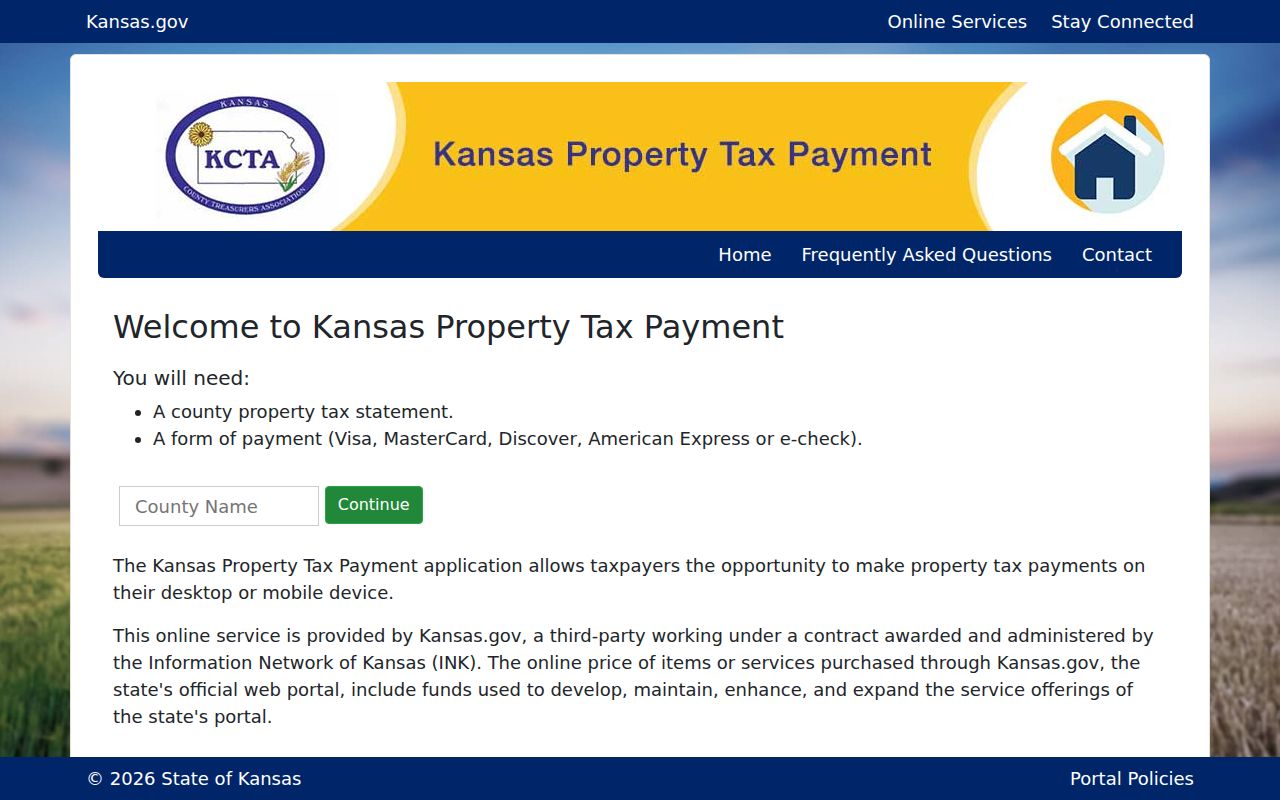
Read any page image as a starting point. It proves neither a balance nor a bill's availability. The Treasurer stays the direct answer for a failed match, a historical statement, or a status that may have shifted.
Gove County Valuation Calendar
Kansas sets its valuation date on January 1, and Gove County works forward from there. The county appraiser mails valuation notices by March 1. Informal meetings must wrap up by May 15. The appraiser then issues a final determination by May 20 and certifies all values to the county clerk on June 1. By November 1 the treasurer takes delivery of the tax roll, the document that turns appraised values into actual tax bills.
Payment statements go out by December 15. The first half, or the full amount, comes due December 20. The second half waits until May 10. Those deadlines matter because each record answers a different question. A valuation notice opens the equalization appeal, while a tax statement starts collection and any payment-under-protest claim tied to your property tax bill.
Note: Confirm the current year's dates with the office because weekends, mailing dates, and statutory changes can affect a filing.
Contest a Gove County Assessment
An equalization appeal challenges the valuation notice and is due within 30 days of mailing. Begin with the Appraiser. Bring parcel-specific facts: the notice, photos, measurements, and condition evidence. Include the correct classification and comparable sales where relevant. Add any deed or survey that fixes the tract. Ask what drove the land and improvement figures. Do not argue from the tax total alone.
Payment under protest is a separate route tied to the tax payment itself. The Kansas Board of Tax Appeals form requests the property and year, value and classification, tax payments, county calculations, grounds, and a signature. File it through the Treasurer under the applicable deadline. Kansas bars an equalization appeal and a payment-under-protest appeal running at the same time. That limit applies to one property and year.
Protect the deadline. File an equalization appeal within 30 days after the valuation notice is mailed, and confirm receipt with the Gove County Appraiser.
Gove County Delinquent Tax Notices
Under K.S.A. 79-2302, the County Treasurer must draw up a delinquent real-estate list. The window runs between July 1 and July 10. A sale notice may follow on or after the first Tuesday in September. Each entry can show the owner of record. It may also list a legal description or address, plus the amount due. Gove County publishes no searchable current delinquency database, so paper trails matter here.
The Gove County Advocate ran public notices in 2024 and 2025. Those notices serve as useful leads. One cited exact legal descriptions, including Grainfield Block 1 and the Grinnell Bechard Addition. A published notice is only a snapshot, though. Verify any later payment, redemption, sale, tax deed, or release before relying on it. Check with the Treasurer and the Register of Deeds.
Gove County Levy Sheet Clues
Gove County's 2024 levy sheet lists valuation bases for its cities. Quinter sits at $6,970,464, Grainfield at $2,523,573, and Grinnell at $2,555,554. Park, Gove, and the portion of Oakley inside the county appear as well. These figures support levy work for Gove County property records. They are not median prices, a sales trend, or a combined market value for homes.
Treat the sheet as context. Match the parcel to its city. Then return to the individual parcel record. Levies from schools, cities, the county, and special districts can shift the final tax bill. Two parcels may carry similar assessed values on the tax roll but face different rates.
Request Older Gove Tax Records
Missing a tax statement, historical appraisal card, correction file, or levy record? Contact the office that created it. Describe Gove County and the parcel number. Include the owner of record, address, and legal description. Add the record type, year range, and preferred format. Ask to inspect records if copies are not needed. A quick phone call can locate the right series before a written request goes in.
The Kansas Open Records Act guidance confirms that any person may request nonexempt public records. The agency must respond as soon as possible. It must respond no later than the third business day, or explain the delay. Copy, search, retrieval, and redaction costs may apply. Request an itemized estimate before work begins.